

The Whole Armor of God · Part 2 of 7
How To Put Onthe Breastplate of Righteousness
“Stand firm then… with the breastplate of righteousness in place”Ephesians 6:14
The breastplate of righteousness guards your heart against Satan’s accusations.
This is the second of seven articles in our Whole Armor of God series. In Ephesians 6:10–18, Paul tells believers how to stand firm in a spiritual battle. Each article looks at one piece of that armor: how a soldier used it, how Satan attacks in that area of your life, and how you can put it on each day. The first article covered the belt of truth.
Ephesians 6:10–18 (NIV)
10Finally, be strong in the Lord and in his mighty power. 11Put on the full armor of God, so that you can take your stand against the devil’s schemes. 12For our struggle is not against flesh and blood, but against the rulers, against the authorities, against the powers of this dark world and against the spiritual forces of evil in the heavenly realms. 13Therefore put on the full armor of God, so that when the day of evil comes, you may be able to stand your ground, and after you have done everything, to stand. 14Stand firm then, with the belt of truth buckled around your waist, with the breastplate of righteousness in place, 15and with your feet fitted with the readiness that comes from the gospel of peace. 16In addition to all this, take up the shield of faith, with which you can extinguish all the flaming arrows of the evil one. 17Take the helmet of salvation and the sword of the Spirit, which is the word of God. 18And pray in the Spirit on all occasions with all kinds of prayers and requests. With this in mind, be alert and always keep on praying for all the Lord’s people.
What Did a Soldier’s Breastplate Do?
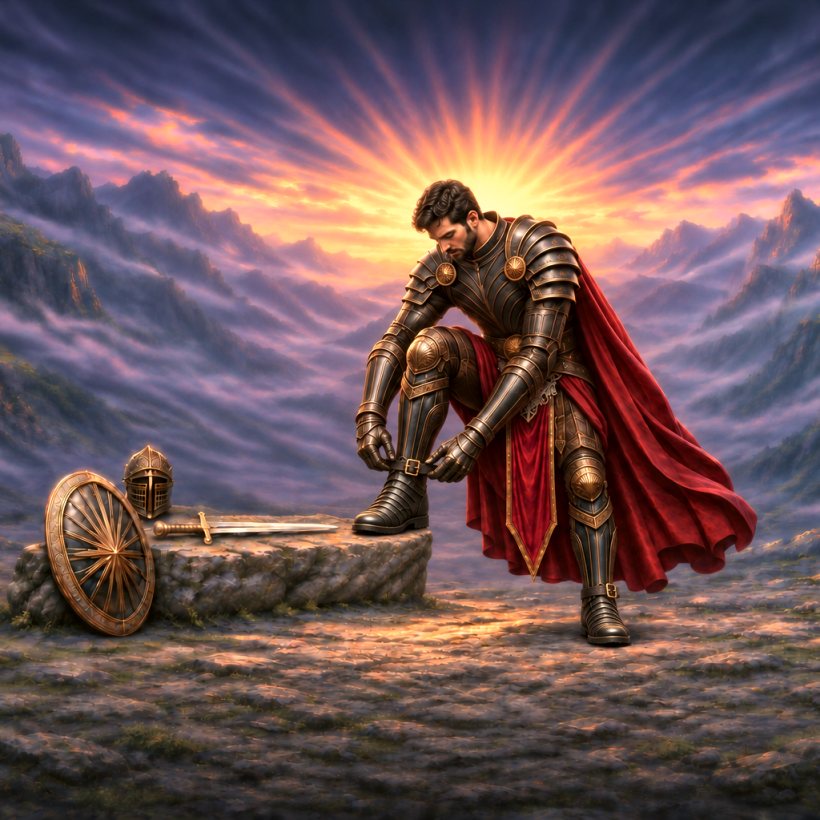
A soldier could fight on with a wounded arm or leg. A wound to the chest was most likely fatal. The breastplate guarded his “vital organs—especially his heart.”1 Paul names the breastplate of righteousness second for good reason. The belt of truth comes first, so that everything that follows rests firmly on God’s truth rather than on man-made traditions.
About two centuries before Paul, the historian Polybius wrote that Rome’s common soldiers wore bronze plates over their chests and called them “heart protectors.”2 By Paul’s day, a Roman soldier was more likely to wear a shirt of iron mail, a flexible garment woven from thousands of small interlocking iron rings and weighing around twenty pounds,3 or a set of overlapping iron bands, which were curved strips of iron strapped around the body like a shell.4 The design had changed, but the job had not. Even a small gap could be deadly. King Ahab rode into battle in disguise, yet “someone drew his bow at random and hit the king of Israel between the sections of his armor” (1 Kings 22:34).
Your spiritual heart needs the same protection. Scripture tells us, “Above all else, guard your heart, for everything you do flows from it” (Proverbs 4:23). Like the belt, this armor was God’s before it was yours: “He put on righteousness as his breastplate” (Isaiah 59:17). You can’t forge your own righteousness. Paul wanted to be found not having a righteousness of his own but having the righteousness that comes from God through faith in Christ (Philippians 3:9). As Alexander Maclaren, a nineteenth-century Baptist preacher, wrote, this righteousness is “not to be self-elaborated, but to be received.”5 In plain terms, you don’t build it; you accept it. Jesus took your sin and gave you His righteousness (2 Corinthians 5:21; 1 Corinthians 1:30). That is your standing before God: you are counted right in His eyes. Then you live out what you’ve been given, day by day (Ephesians 4:24).
“the accuser”
Revelation 12:10
How Satan Attacks Your Self-Worth
But what about sin that creeps into your day? The David Jeremiah blog warns that tolerated small sins create “dangerous ‘holes’ in our bulletproof vests.”1 Those holes don’t change your standing with God, but they do leave your heart exposed. Satan uses that vulnerability in your armor to attack your self-worth. He is “the accuser” (Revelation 12:10), and he aims at the heart. Zechariah saw him stand beside Joshua the high priest to accuse him, while Joshua stood in filthy clothes (Zechariah 3:1–3). God didn’t debate Joshua’s record. He said, “See, I have taken away your sin, and I will put fine garments on you” (Zechariah 3:4).
One way Satan brings his accusations against you is by using painful events to suggest that God is punishing you. God may discipline you, like a loving father disciplines their child. But He does not punish a true believer for continuous sin in a legal sense or with retribution. This is because Jesus Christ fully absorbed God’s wrath and penalty for all past, present, and future sins on the cross (Romans 8:1). God even rebuked Job’s friends (Job 4:7–8; 42:7) for suggesting he was being punished when he lost his family, wealth, possessions, health, and social standing.
Satan feeds your doubts until you wonder how God could still love or use you. And he uses sin to drive you into hiding, as Adam hid (Genesis 3:8–10). Hiding can hurt emotionally and physically. David said that when he hid his sins, his bones wasted away and his strength was sapped (Psalm 32:3-4). Satan’s condemnation must have stolen David’s joy in the Lord because he asked God to “Restore to me the joy of your salvation” (Psalm 51:12–13).
Satan also works the opposite edge, tempting you to trust your own goodness (Luke 18:9–14). Either way, he wants a believer who stops serving, stops praying boldly, and stops telling others about Jesus. Yet, when we tune into God’s voice, we’re reminded of His unwavering love and our rightful place in Christ.
My story
I hid my faith from others and hid my sin from God.
I accepted Christ’s salvation by faith in sixth grade, and spiritual fruit was evident. But my family was part of a church that did not encourage spiritual disciplines like Bible study. Instead, they taught that you earn salvation through works and penance. As a result, when I fell under the pressure of my high school peers, my walk with Jesus suffered. I hid my faith from others and hid my sin from God. Fifteen years later, when I returned to walking closely with Jesus, it took me a while to understand that I was righteous because of what Christ did for me. The Father did not hide his face from me but saw me as righteous through my faith in Christ.
Today, I put on the breastplate of righteousness by regularly asking God to reveal the gaps in my armor and remind me who I am in Christ. I am forgiven, chosen, and loved.
How To Put It On
- Receive Christ’s righteousness as a gift. You cannot earn it, and if your faith is genuine, you cannot lose it.
- Confess sin quickly and accept His forgiveness rather than carrying guilt (1 John 1:9).
- When you feel unworthy, say aloud who you are in Christ. You are forgiven, chosen, and loved.
- Close the small gaps. Ask God to show you any compromise you’ve been excusing and deal with it today (Ephesians 4:24).
- Invite a trusted believer to ask you honest questions and pray for each other (James 5:16).
Benefits of Putting On This Armor
- Freedom from condemnation
- You serve God out of gratitude, not to earn His approval (Romans 8:1).
- Bold confidence
- With nothing to hide, you can approach God and face people without fear. God’s Word says the righteous can “approach God’s throne of grace with confidence” (Hebrews 4:16). They are “as bold as a lion” (Proverbs 28:1).
- Powerful prayer
- “The prayer of a righteous person is powerful and effective” (James 5:16).
- Fruit that honors God
- A life filled with “the fruit of righteousness” points people to Jesus, “to the glory and praise of God” (Philippians 1:11).
Write Your Own Story
Your experiences are part of how God shapes your walk with Him. “Let the redeemed of the LORD tell their story” (Psalm 107:2). Set aside 15 minutes, ask God to bring the right memory to mind, and work through these steps.
- Name the accusation.Write down the accusation from Satan that has followed you the longest.
- Remember how it shaped you.When did it begin? How did it change the way you prayed, served, or saw yourself?
- Find the truth.What Scripture, person, or experience reminded you that you are righteous in Christ?
- Write your story.Finish these sentences: “The accusation from Satan that stuck to me the longest was ____. What silenced it was ____. What helped me regain my bold confidence to approach the throne of God was ____.”
- Share it.Thank God for what He has done, then tell one trusted person your story this week.
Memorize
God made him who had no sin to be sin for us, so that in him we might become the righteousness of God.2 Corinthians 5:21


Copyright 2026. All rights reserved